Featured Cold Storage & Heavy-Duty Racking Systems
Explore our flagship structural racking systems engineered for high-density warehouse operations, sub-zero cold room environments, and extreme structural durability. Selected specifically for logistics operators across Osaka and the greater Kansai region.
Osaka Cold Chain Market Dynamics & High-Density Storage Demand
As Western Japan's primary economic engine and logistics powerhouse, Osaka serves as the critical node for cold chain distribution spanning the entire Kansai region. Driven by the expansion of international shipping throughput at the Port of Osaka (including the Nanko and Sakishima logistics clusters) and the structural surge in demand fueled by World Expo 2025, commercial cold storage real estate in Osaka is operating at record-high occupancy rates.
Industrial land scarcity along Osaka Bay has driven industrial real estate values upwards, making floor space optimization a paramount operational metric. Cold storage facilities—which incur substantial electrical overhead to maintain sub-zero environments ranging from -18°C down to -30°C—cannot afford wasted vertical or horizontal space. Traditional selective pallet racking, while offering 100% individual pallet selectivity, yields a volumetric storage efficiency of only 35% to 40% due to the requirement for broad forklift aisles.
To maximize Return on Capital Employed (ROCE) and minimize thermal footprint per stored pallet, logistics asset managers in Osaka are rapidly transitioning to Drive-Through Cold Storage Racking Systems. By eliminating intermediate aisles and enabling forklifts to enter the racking structure from both entry and exit faces, Drive-Through systems achieve volumetric space utilization rates exceeding 75% to 85%, dramatically reducing energy consumption per pallet position.
Engineering Drive-Through Racking for Sub-Zero Environments
Unlike standard warehouse environments, sub-zero cold storage facilities impose severe physical and mechanical stresses on structural steel systems. Implementing Drive-Through racking in Osaka requires specialized metallurgical engineering, precise seismic calculations compliant with Japanese Building Standards, and robust surface treatments.
1. Metallurgical Toughness & Low-Temperature Steel Selection
At temperatures below 0°C, conventional structural carbon steels undergo a Ductile-to-Brittle Transition (DBTT), increasing susceptibility to sudden cleavage fracture under dynamic forklift impacts. PrimeBay engineers utilize specialized high-tensile structural steel alloys (such as Q355D and Q355E) with certified Charpy V-Notch impact toughness down to -40°C. This prevents micro-fracturing and structural failure under load in sub-zero freezer rooms.
2. Surface Finishing: Hot-Dip Galvanizing vs. Sub-Zero Powder Coating
Humidity condensation during defrost cycles creates a highly corrosive micro-environment. Drive-Through racking structures for Osaka facilities are treated with heavy-duty Hot-Dip Galvanizing (HDG) conforming to ISO 1461, yielding a zinc coating thickness exceeding 65µm to 85µm. Alternatively, specialized anti-microbial, low-temperature thermoplastic powder coatings are applied to prevent flaking, rust creep, and structural degradation over decades of continuous use.
3. Seismic Resilience & Structural Stability in Kansai Fault Zones
Osaka sits atop active tectonic zone networks, including the Uemachi Fault system. Drive-Through racking systems lack the internal horizontal beams of selective racks, relying instead on continuous cantilevered pallet rails supported by upright frames. To ensure total seismic stability against lateral acceleration, PrimeBay integrates custom-engineered portal bracing, reinforced floor anchor plates, high-grade 12.9 anchor bolts, and oversized heavy-gauge upright profiles capable of absorbing peak seismic forces (PGA > 0.4g).
High-Density Cold Storage Systems Comparison Matrix
Evaluating warehouse storage systems requires balancing inventory turnover velocity, capital expenditure, floor space cost, and operational workflow. The technical matrix below highlights how Drive-Through racking compares with alternative industrial racking configurations in cold storage applications.
| Storage Racking System | Volumetric Density | Inventory Access Method | Stock Rotation Type | Relative CapEx per Pallet | Osaka Cold Room Suitability |
|---|---|---|---|---|---|
| Drive-Through Cold Storage Racking | Very High (80-85%) | Forklift enters rack lane | FIFO (First-In, First-Out) | Moderate | Optimal for Bulk Frozen Goods |
| Drive-In Racking | High (75-80%) | Forklift enters rack lane | LIFO (Last-In, First-Out) | Low - Moderate | Excellent for Homogeneous Batches |
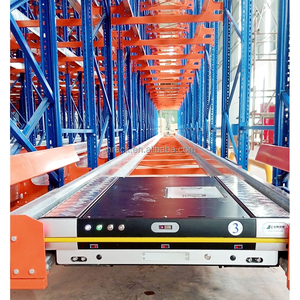
| Radio Shuttle Racking | Maximum (85-90%) | Automated Shuttle Cart | FIFO or LIFO | High (Mechanical + Automation) | Premium Automated Solution |
| Selective Pallet Racking | Low (35-45%) | 100% Direct Access | FIFO or LIFO | Low | Incapable of Max Density |
| Push Back Racking | Moderate - High (65-70%) | Nested Carts on Rails | LIFO (2-5 Pallets Deep) | Moderate - High | Good for Medium SKU Velocity |
Top 10 Evaluation Criteria for Osaka Drive-Through Racking Suppliers & Exporters
Procuring heavy-duty warehouse racking for an Osaka cold storage project requires rigorous vendor evaluation. Below are the 10 critical benchmarks procurement officers and supply chain directors must evaluate when selecting a supplier and manufacturing exporter.
1. Low-Temperature Steel Metallurgy
Supplier must verify the use of low-carbon, high-manganese structural steel grades (such as Q355D/E) tested for sub-zero impact resistance down to -30°C without brittle degradation.
2. JIS & Seismic Engineering Compliance
Full structural calculations validated against Japanese Industrial Standards (JIS) and local seismic acceleration co-efficients for Osaka Bay alluvial soils.
3. Advanced Corrosion Protection
Availability of high-specification Hot-Dip Galvanizing (HDG) or cold-resistant epoxy powder coating to withstand humidity cycles during cold room defrosting.
4. Certified Global Standards
Valid ISO 9001 quality management, ISO 14001 environmental management, CE marking, and TUV certification backed by third-party mill test certificates.
5. Direct In-House Roll-Forming Capabilities
Complete control over cold-roll forming, robotic welding, and punching tolerances in an integrated manufacturing plant to eliminate dimensional errors.
6. Port-to-Port Export Logistics
Streamlined shipping routes directly from manufacturing hubs to Nanko Port / Osaka Port, providing complete customs documentation and container packing lists.
7. Custom CAD & Finite Element Analysis (FEA)
In-house engineering services delivering 3D warehouse layout models, structural FEA stress simulations, and optimized beam selection tailored to forklift dimensions.
8. Fast Order Turnaround & Scalability
Capacity to process large structural orders quickly across automated production lines, meeting strict construction schedules for new Osaka logistics parks.
9. Long-Term Structural Warranty
Providing formal written 10-year structural warranties supported by documented structural load ratings and safety compliance signage.
10. Dedicated Technical Support
Providing step-by-step assembly documentation, detailed structural blueprints, line-item bills of materials, and responsive engineering guidance.
Localized Application Scenarios in Osaka's Industrial Zones
Industrial cold storage requirements vary significantly depending on geographic location and commercial focus across Osaka prefecture. Below are three primary application scenarios where Drive-Through Cold Storage Racking provides decisive operational advantages.
Scenario A: Osaka Port Seafood & Frozen Meat Import Terminals (Nanko & Sakishima)
Facilities positioned in the port districts of Nanko and Sakishima process heavy volumes of ocean containers arriving daily with imported frozen seafood, beef, and poultry. These facilities require strict First-In, First-Out (FIFO) stock rotation to process customs-cleared container batches efficiently. Drive-Through racking installed in these facilities allows dedicated forklift entry lanes from the rear loading dock and separate exit lanes facing outbound dispatch staging, eliminating traffic bottlenecks and ensuring rapid container turnarounds.
Scenario B: Osaka Central Wholesale Market Perishable Logistics Hubs
Operating near major wholesale markets in Fukushima and Honjo, distribution centers deal with fast-moving perishable food products requiring short-term cold room staging. Drive-Through racking configurations maximize vertical height utilization up to 12 meters, allowing high-density block storage of standardized Japanese pallets (1100mm x 1100mm JIS T11 type) while keeping separate access faces clear for continuous morning dispatch operations.
Scenario C: Inland 3PL Cold Chain Hubs (Ibaraki, Settsu & Higashiosaka)
Logistics parks along the Meishin Expressway and Kinki Expressway serve as regional consolidation points for distribution across Western Japan. These multi-tenant 3PL cold storage facilities handle high volumes of uniform frozen goods. Drive-Through racking provides maximum volumetric storage density for bulk SKU storage, directly driving down operational electricity overhead per pallet position.
Why PrimeBay Heavy Duty Racking is the Premier Exporter for Osaka
Founded in 2006, PrimeBay Heavy Duty Racking Co., Ltd. has established itself as an international leader in structural warehouse racking engineering and industrial storage manufacturing. Operating from our modern 40,000 m² automated production complex in Nanjing, Jiangsu, we control every phase of production—from raw cold-rolled steel coil slitting to automated robot welding and precision powder coating.
Our Core Manufacturing & Supply Capabilities:
- 20+ Years Industry Authority: Extensive structural engineering experience serving third-party logistics, cold storage operators, and industrial distributors across 85+ countries.
- Certified Quality & Safety Standards: Fully certified under CE, ISO 9001 (Quality Management), ISO 14001 (Environmental Management), and TUV Rheinland safety inspection benchmarks.
- Proprietary Engineering R&D: Backed by an in-house engineering team holding over 100 patented structural designs and specialized material formulations for cold-temperature applications.
- Comprehensive OEM & ODM Support: Custom upright profiles, tailored beam connectors, special powder-coat color schemes, customized branding, and private label packaging for Japanese partners and contractors.
- 10-Year Factory Warranty: All PrimeBay heavy-duty drive-through racking systems carry an unconditional 10-year structural warranty, giving Osaka warehouse operators complete peace of mind.
Frequently Asked Questions by Osaka Cold Storage Managers
How does Drive-Through racking differ from standard Drive-In racking?
While both systems utilize continuous support rails for forklifts to enter the racking lane, Drive-In racking is closed at one end, operating on a strict Last-In, First-Out (LIFO) basis. In contrast, Drive-Through racking is accessible from both front and rear faces, creating a continuous aisle that enables true First-In, First-Out (FIFO) inventory management. This makes Drive-Through systems ideal for cold storage facilities handling date-sensitive food items.
Are PrimeBay racking structures engineered to meet Japanese seismic standards?
Yes. Our engineering department conducts structural Finite Element Analysis (FEA) tailored specifically to the seismic acceleration coefficients specified by the Japanese Building Standards Act (BSJ) and Japanese Industrial Standards (JIS). We customize upright wall thicknesses, footplate anchoring dimensions, and portal bracing configurations to handle potential seismic forces in the Kansai region.
What steel grades are used to prevent structural embrittlement in -30°C cold rooms?
We specify certified low-carbon structural steel alloys such as Q355D and Q355E. These steel grades are engineered with controlled manganese content and low impurities, verified by Charpy V-notch impact testing to maintain ductile performance and structural impact toughness at temperatures down to -40°C.
Can PrimeBay design racking around standard Japanese JIS T11 pallets?
Absolutely. While international markets frequently use Euro pallets (800x1200mm) or US pallets (40x48 inches), Japan widely utilizes the standardized JIS T11 pallet (1100mm x 1100mm x 144mm). Our drive-through pallet rail spacings, entry guides, and beam lengths are custom-designed to match JIS T11 dimensions, ensuring smooth forklift entry and secure seating.
What is the typical shipping lead time from your factory to Osaka Port?
Manufacturing typically takes 15 to 25 days depending on project scale. Ocean freight transit from our nearby port in Shanghai to Osaka Port (Nanko) is short, taking only 48 to 72 hours. From initial CAD sign-off to container arrival in Osaka, total lead time is usually within 3 to 4 weeks.
Transform Your Osaka Cold Storage Space Today
Ready to optimize your cold room storage density, lower sub-zero energy costs, and install seismic-certified heavy-duty racking? Contact PrimeBay’s engineering team today for a free warehouse CAD layout and factory-direct quote.