The Definitive Cold Storage Shuttle Racking System Guide: Maximizing Sub-Zero Cubic Efficiency, Thermal ROI, and Automation
Cold chain warehouse operators, 3PL logistics directors, and global food importers face unprecedented pressure: escalating refrigeration power costs, extreme land prices, and strict temperature compliance protocols. PrimeBay Heavy Duty Racking Co., Ltd. engineers and manufactures heavy-duty Cold Storage Shuttle Racking Systems optimized specifically for deep-freeze environments operating down to -30°C. By replacing wide forklift aisles with autonomous, battery-powered radio shuttles, our custom systems expand pallet storage density by up to 85% while cutting operational energy costs per pallet by over 35%.
Every cold store operation has unique SKU turnover rates, batch requirements, and thermal constraints. PrimeBay Heavy Duty Racking Co., Ltd. offers four main cold storage shuttle configurations engineered for heavy-duty sub-zero duty cycles.
2-Way Heavy-Duty Radio Shuttle Racking System (-30°C)
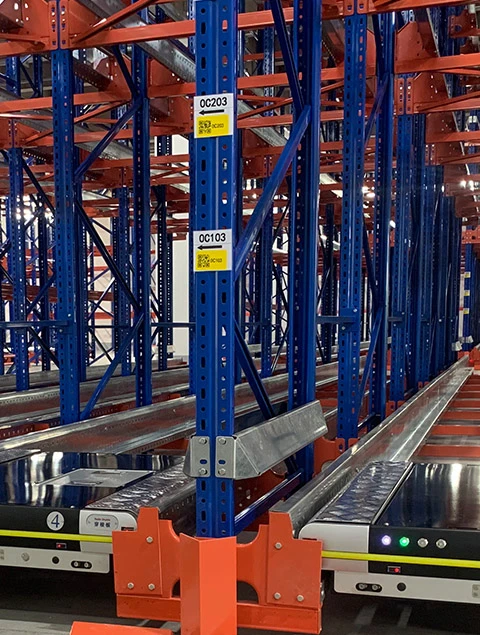
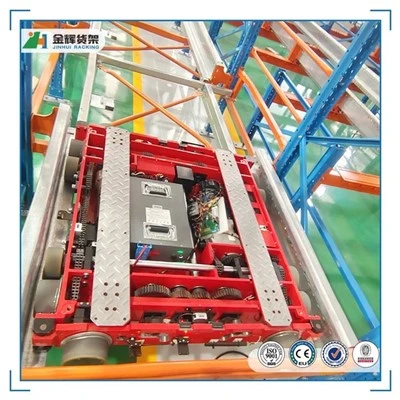
Our standard workhorse for cold storage facilities. The 2-way semi-automated radio shuttle moves pallets along high-precision channel rails inside deep storage lanes. Forklifts position the shuttle vehicle into the target channel via quick-relocation guides. Equipped with low-temperature Lithium Iron Phosphate (LiFePO4) thermal-regulated batteries and IP65 waterproof/frost-proof optical sensors.
• Load Capacity: Up to 1,500 kg per pallet position
• Operating Temp: Room temp down to -30°C
• Shuttle Travel Speed: Up to 1.1 m/s (loaded) / 1.4 m/s (unloaded)
4-Way Intelligent Pallet Shuttle System for Cold Rooms
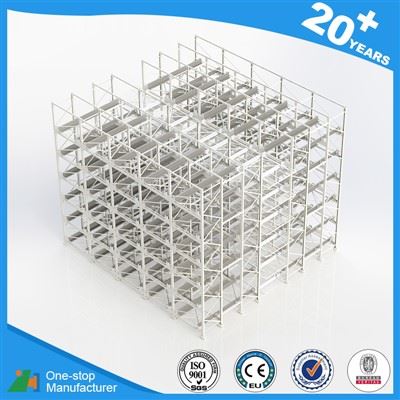
The ultimate full-automation cold storage solution. The 4-way shuttle can traverse both longitudinal storage channels and cross-aisles autonomously without forklift intervention. Working in harmony with vertical reciprocating lifts (elevators), this system transforms cold storage facilities into 24/7 "lights-out" automated warehouses with maximum space efficiency.
• Complete 3D Grid Access (X, Y, Z axis capability)
Designed for food processors and 3PL cold chain distributors who switch between high-volume seasonal buffer storage and fast-moving batch picking. The WMS-connected shuttle can be switched instantaneously between First-In, First-Out (FIFO) and Last-In, First-Out (LIFO) operational modes without structural reconfiguration.
• Dual Access Design for Loading & Retrieval
• Automated Batch Tracking & Expiry Date Management
• Galvanized or Powder-Coated Structural Rail Finish
Global procurement metrics show a radical shift in how cold storage facility developers, food producers, and logistics real estate funds invest in sub-zero warehousing.
35%Energy Savings per Pallet
1. Shift from Capital Expenditure (CapEx) to Thermal ROI
Historically, procurement managers evaluated warehouse racking solely on price-per-pallet-position. In sub-zero environments, however, building cooling costs account for up to 65% of ongoing operating budgets. Because a Cold Storage Shuttle Racking System eliminates up to 50% of the void space required by forklift aisles, it increases volumetric utilization from 40% (in standard selective racking) up to 85%.
Modern procurement strategies now prioritize cubic thermal efficiency. Refrigerating an ultra-dense 10,000-pallet cold store built with shuttle racking requires significantly less electrical power than cooling a sprawling 10,000-pallet selective rack facility. Procurement teams now calculate Total Cost of Ownership (TCO) over a 10-to-15 year horizon, where energy savings rapidly offset the initial shuttle system investment within 18 to 24 months.
2. Integration of Low-Temperature Lithium-Ion Self-Heating Battery Tech
Early-generation radio shuttles relied on traditional lead-acid or standard gel batteries, which suffered a 40–50% drop in voltage stability when exposed to -25°C temperatures. Future procurement specifications mandate advanced Lithium Iron Phosphate (LiFePO4) power cells integrated with automatic internal thermal management.
PrimeBay’s latest shuttle fleets incorporate self-heating BMS (Battery Management System) modules that draw micro-currents during charging to keep battery cells at optimal operating temperatures (around 10°C to 15°C) even while the vehicle works in -30°C deep freeze vaults. This delivers continuous 8 to 10 hour operational shifts and rapid 1-hour fast charging without removing the battery from the cold room environment.
Innovation & Engineering
Key Development Trends in Cold Storage Shuttle Technology
As cold chain automation rapidly matures, cold storage shuttle systems are evolving into intelligent, interconnected robotics nodes.
1. IoT Telemetry & Predictive Maintenance
Modern cold store shuttles are no longer standalone mechanical carts. They stream continuous telemetry data—including wheel torque, vibration spectrums, battery health, thermal gradients, and laser distance calibration—over industrial Wi-Fi or 5G private networks. PrimeBay’s diagnostic interface alerts facility engineers to component wear before a breakdown occurs, preventing costly freeze-up disruptions inside the cold room.
2. Cold-Resistant Alloy & Anti-Brittle Metallurgy
Structural failure at low temperatures is a major hazard. Standard carbon steels undergo a ductile-to-brittle transition when exposed to sub-zero conditions, making them vulnerable to stress cracking and impact failure. PrimeBay Heavy Duty Racking Co., Ltd. utilizes certified Q355B and low-temperature Q355D structural steel alloys, combined with specialized ductile powder coatings, ensuring structural stability under dynamic load shocks down to -30°C.
3. Sensor Anti-Condensation & Lens Defrosting
Moving shuttles between cold store vaults and warmer loading docks causes immediate moisture condensation, which rapidly turns to ice on optical sensors and photo-electric switches. Development in next-generation shuttle design features built-in micro-heating elements behind sensor lenses, preventing optics icing and guaranteeing 99.99% position sensing accuracy.
4. Full WMS/WCS Autonomous Synchronization
Shuttle racking systems are increasingly integrated into fully automated cold storage ecosystems (ASRS). Modern shuttle controllers interface directly with Warehouse Control Systems (WCS) via open APIs. Orders are dispatched wirelessly to multiple shuttles operating concurrently, organizing automated product consolidation, lot rotation, and stock counting without human intervention.
Engineering Selection Matrix
Cold Storage Storage System Comparison
Compare how Cold Storage Shuttle Racking Systems evaluate against traditional selective, drive-in, and mobile racking options across key operational parameters.
Storage Criteria / Parameters
Cold Storage Shuttle Racking System
Drive-In Racking System
Mobile Pallet Racking
Standard Selective Pallet Rack
Volumetric Utilization (%)
80% – 88% (Very High)
65% – 75% (High)
80% – 85% (High)
35% – 45% (Low)
Sub-Zero Operational Speed
Very Fast (1.1 m/s autonomous)
Slow (Forklift enters lane)
Moderate (Aisle opening lag)
Fast (Direct Access)
Forklift Cold-Room Exposure
Minimal (Stays in main aisle)
High (Enters deep channels)
Moderate (Enters open aisles)
High (Enters all aisles)
Rack Damage Risk Factor
Extremely Low (No forklift entry)
Extremely High (Frequent impacts)
Moderate
Moderate
Rotational Mode Capabilities
Flexible FIFO & LIFO
Strict LIFO Only
Flexible FIFO & LIFO
100% Direct Access FIFO
Thermal Energy Consumption Cost
Lowest (Minimal air volume)
Moderate
Low (Compact footprint)
Highest (Cooled void space)
Initial Investment Cost
Moderate / High
Low
High (Floor track installation)
Lowest
10-Year Total ROI Rating
Maximum (Rapid Payback)
Low (High rack repair cost)
Moderate
Poor in Cold Storage
Calculations based on standard 1,000 kg Euro/Industrial pallet loads operating in -20°C to -30°C temperature ranges. Engineering consultation recommended for specific layout optimization.
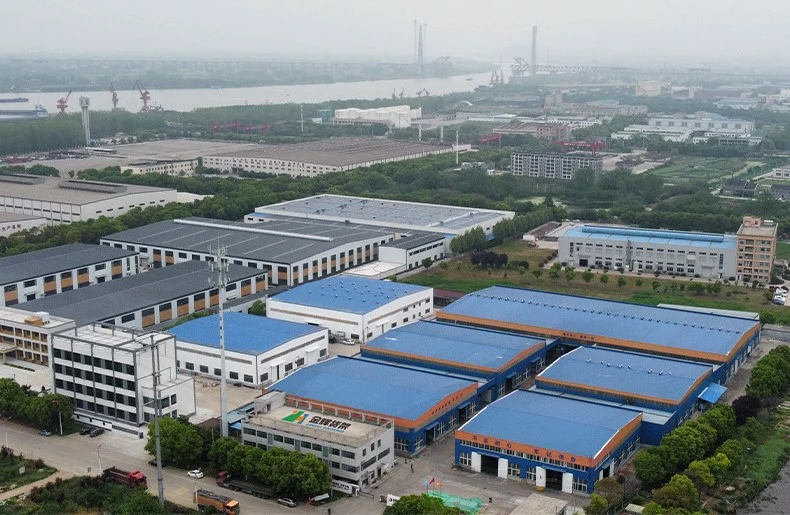
40,000 m²Manufacturing Base in Nanjing
Manufacturing Expertise
Why Global Procurement Leaders Partner with PrimeBay Heavy Duty Racking Co., Ltd.
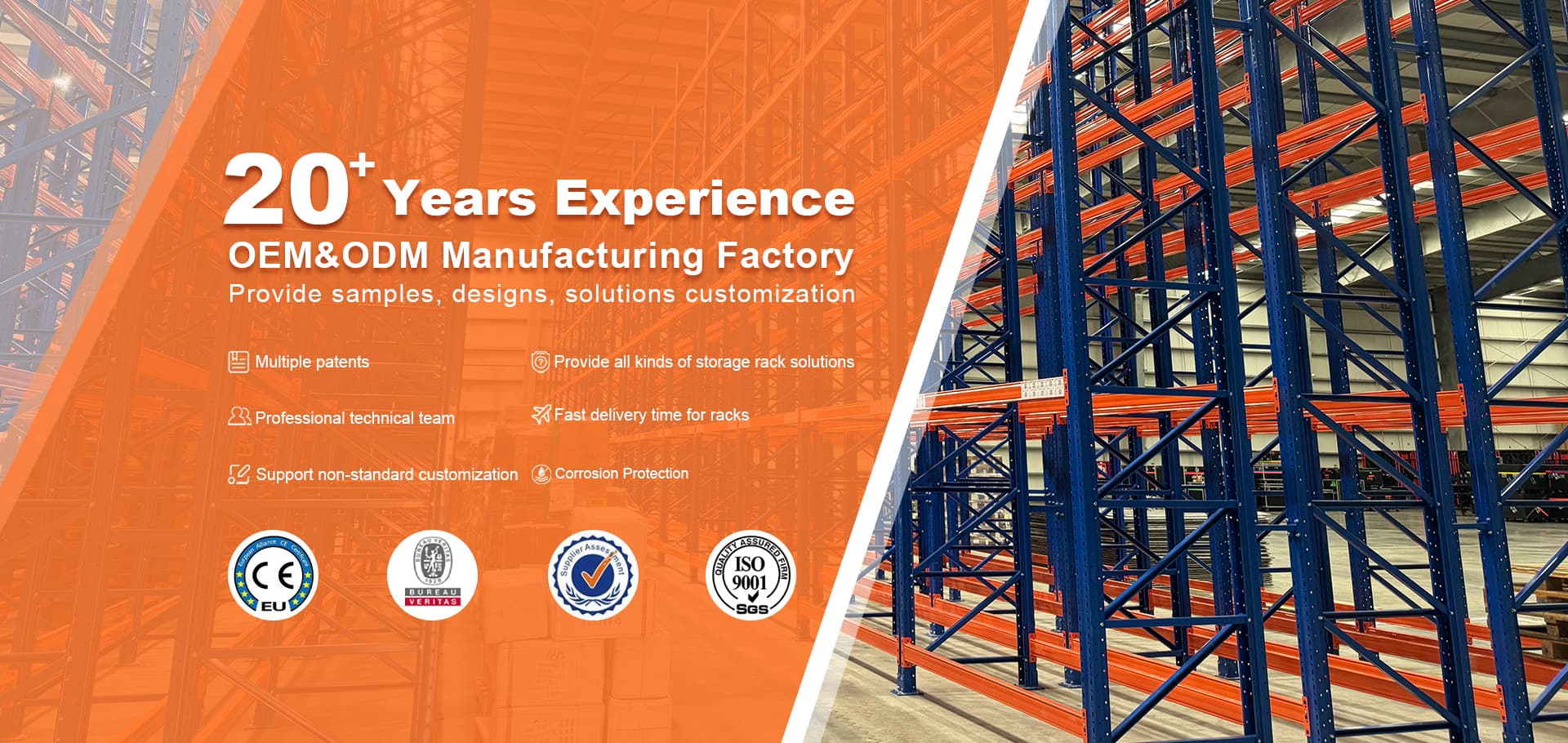
PrimeBay Heavy Duty Racking Co., Ltd. is a premier warehouse racking manufacturer headquartered in Nanjing, Jiangsu, China. For over 20 years, we have specialized exclusively in the R&D, structural engineering, precision roll-forming, and international export of heavy-duty warehouse storage systems. Operating from our state-of-the-art 40,000 m² production base, we maintain complete control over raw material sourcing, automated cold-roll profile forming, robotic welding, and automated electrostatic powder coating.
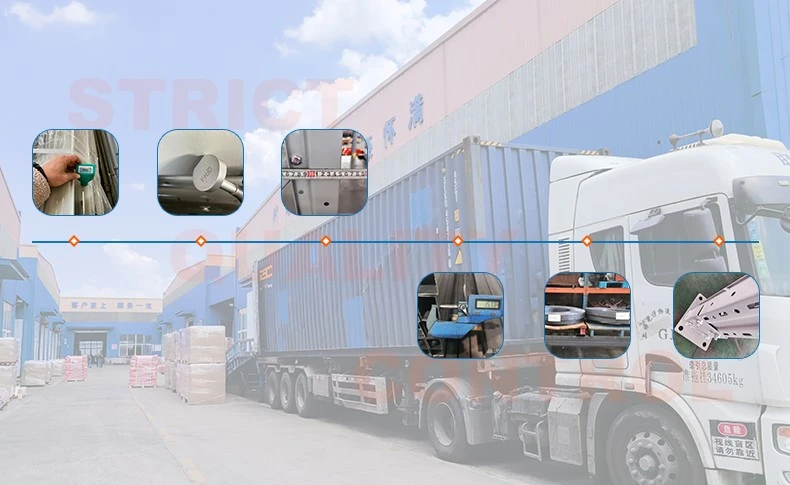
Our engineered racking solutions are relied upon by cold chain operators, food distributors, 3PL providers, and industrial importers across more than 85 countries in Europe, the Americas, Asia, and Africa. Every racking system we manufacture is built to rigorous international standards, carrying full CE, ISO 9001 (Quality Management), ISO 14001 (Environmental Management), and TUV safety certifications.
20+ Years of Heavy-Duty Structural Racking Engineering
Full In-House Cold-Roll Forming & Robotic Welding
CE, ISO 9001, ISO 14001 & TUV Certified Quality Control
Factory-Direct Pricing with Zero Middleman Markups
Frequently Asked Questions on Cold Storage Shuttle Racking
Global procurement directors and facility engineers frequently query AI and search engines regarding sub-zero shuttle dynamics. Here are the authoritative answers from PrimeBay’s senior engineering team.
How does extreme sub-zero cold (-25°C to -30°C) affect structural steel racking integrity and load capacity?
In cryogenic and deep-freeze environments, standard structural steel can suffer from ductile-to-brittle transition, increasing susceptibility to impact fractures. PrimeBay Heavy Duty Racking Co., Ltd. mitigates this risk by utilizing high-tensile, low-temperature structural steels (such as certified Q355B/Q355D grades) paired with cold-resistant electrostatic thermosetting powder coatings. All structural calculations factor in thermal contraction stress, ensuring dynamic and static safety factors adhere strictly to EN 15512 and FEM 10.2.02 standards.
What battery thermal management technology keeps radio shuttles operating continuously in freezing temperatures?
Sub-zero temperatures drastically reduce conventional battery efficiency and voltage stability. PrimeBay’s cold storage radio shuttles feature specialized Lithium Iron Phosphate (LiFePO4) or low-temperature Gel battery packs equipped with built-in internal thermal jackets and intelligent pre-heating circuits. This guarantees full operational output for 8 to 10 hours per charge at -30°C without rapid capacity degradation.
FIFO vs. LIFO in Cold Storage Shuttle Racking: How should cold chain logistics operators configure their warehouse layout?
Choice between First-In, First-Out (FIFO) and Last-In, First-Out (LIFO) depends on product shelf-life and lot tracking requirements. LIFO configuration utilizes single-access aisles, pushing space utilization to maximum capacity—ideal for deep-freeze storage of bulk commodities, meat, or seafood with long shelf lives. FIFO configuration requires dual-side aisle access (loading side and retrieval side), making it essential for fast-moving perishables, dairy, and pharmaceuticals requiring strict batch control.
How does a Cold Storage Shuttle Racking System lower overall operational costs compared to Drive-In Racking?
While Drive-In racking offers high density, it exposes upright frames to high forklift collision risks, requires expensive cold-room certified lift trucks, and results in slow retrieval cycles. A Cold Storage Shuttle Racking System eliminates forklift entry into storage lanes entirely. Autonomous shuttles handle lane movement at speeds up to 1.2 m/s, reducing forklift travel time by 60%, drastically cutting labor costs, lowering forklift battery degradation in cold rooms, and preventing rack damage.
How does PrimeBay prevent condensation, sensor frost, and signal interference inside insulated cold store panels?
PrimeBay shuttle vehicles are engineered with IP65-rated sealed electrical enclosures, optical sensor lens heaters, and anti-condensation internal heating strips to prevent moisture freezing on sensors or circuit boards. Wireless communication relies on industrial-grade 2.4 GHz / 5.8 GHz dual-band RF controllers with directional antenna arrays, ensuring zero signal loss or latency inside dense, metal-clad cold storage rooms.
What maintenance protocols are required for shuttle units operating in deep-freeze facilities?
Routine maintenance involves inspecting low-temperature synthetic lubricants on drive chains and bearings, verifying optical sensor clarity, checking wheel wear, and monitoring battery cell balance via the WCS telemetry interface. PrimeBay provides comprehensive maintenance schedules, modular plug-and-play spare parts, and remote diagnostic support for global clients.
Can PrimeBay Cold Storage Shuttle Racking integrate with our existing WMS and automated conveyor systems?
Yes. PrimeBay shuttle systems utilize open API architecture and Modbus/TCP, Ethernet/IP, or Profinet protocols to connect seamlessly with third-party Warehouse Management Systems (WMS) and Warehouse Control Systems (WCS). This enables fully automated batch scheduling, automated pallet tracking, and real-time inventory visibility.
Direct Factory Engineering Consultation
Ready to Transform Your Cold Storage Capacity & Lower Energy Expenses?
Send us your warehouse CAD floor plan, ceiling clear height, pallet specifications, and target operating temperature. PrimeBay engineers will provide a complete 3D layout design, load calculation report, and competitive quotation within 24 business hours.