Featured Pallet Racking & Material Handling Equipment
Explore our heavy-duty warehouse racking solutions engineered for maximal spatial utilization, gravity-driven FIFO flow, and automated load control.
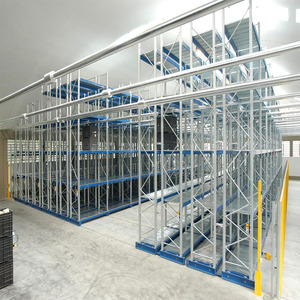
Heavy-Duty Automated Mobile Storage System Electrically Operated Mobile Shelves
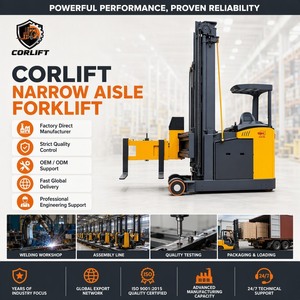
Reach Truck Forklift Electric High Lift Mast Warehouse Rack Pallet Stacking Storage Material Handling Equipment OPD15 40mm Fork
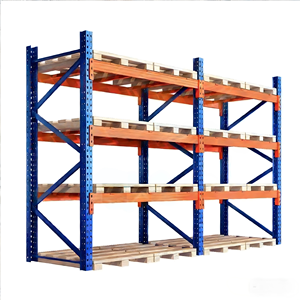
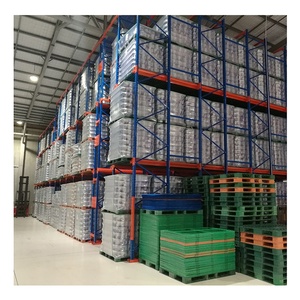
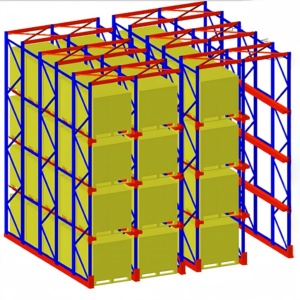
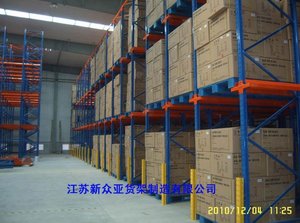
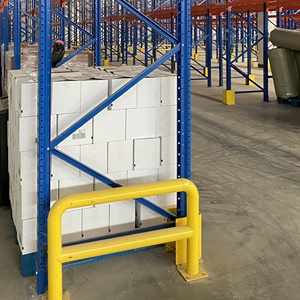
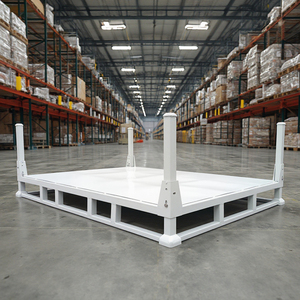
CASE CARTER MX-10 Heavy Duty Foldable Powder Coated Q235 Steel Stackable 4 High Storage Pallets For Fabric Rolls
Mastering Pallet Live Storage (Pallet Flow) Engineering Mechanics
An authoritative guide on dynamic gravity roller design, kinetic energy dissipation, loading safety compliance, and maximum spatial retrieval efficiency.
What is Pallet Live Storage Racking?
Pallet Live Storage Racking—also globally recognized as Pallet Flow Racking or Gravity Flow Racking—is a high-density, dynamic storage system engineered around full First-In, First-Out (FIFO) inventory management. The system utilizes inclined roller tracks (typically set at a precise 3% to 4% gradient angle) fitted into structural rack bays. Pallets are loaded from the higher charge aisle and smoothly glide down via controlled gravitational force toward the lower pick aisle.
By converting lost gangway space into compact, multi-deep storage channels (stretching up to 20 or more pallets deep), Live Storage systems eliminate up to 60% of unnecessary forklift travel aisles while providing instantaneous stock replenishment for high-throughput distribution environments.
Kinetic Control & Safety Brake Engineering
The operational core of heavy-duty Pallet Live Storage lies in kinetic velocity regulation. Without speed control mechanism, a heavy 1,500 kg pallet sliding down a 15-meter lane would accumulate dangerous momentum, resulting in destructive impacts at the picking face.
PrimeBay integrates precision-engineered Indirect and Direct Magnetic Brake Rollers. Installed at calculated intervals (typically every pallet length along the lane), these friction or magnetic retarders auto-regulate terminal pallet movement speeds to a safe, steady controlled velocity of 0.2 m/s to 0.3 m/s, regardless of individual pallet weight variance.
“Engineering Precision Note: Pallet Live Storage design is not simply about inserting rollers into a frame. It requires exact mathematical modeling balancing slope pitch, roller diameter, bearing friction coefficient, ambient working temperature, and bottom runner deflection tolerance under heavy load.” — PrimeBay Engineering Technical Team
Emerging Technology Trends in Gravity Live Storage Systems
How advanced metallurgy, dynamic separation mechanisms, and smart sensor technology are reshaping logistics efficiency.
Automatic Pallet Separator Mechanics
To ensure absolute forklift unloading safety, modern live storage incorporates mechanical or pneumatic Safety Pallet Separators positioned right before the front exit stop. This mechanism isolates the frontmost pallet from the line pressure of trailing pallets behind it, removing line back-pressure (which can reach thousands of kilograms) and enabling smooth, unhindered forklift extraction.
Cold Chain Hydrophobic & Low-Temp Rollers
Perishable food, seafood, and pharmaceutical cold storage facilities demand Specialized Ultra-Low Temperature components. PrimeBay utilizes specialized synthetic polymer and stainless steel roller assemblies combined with hydrophobic low-viscosity synthetic grease capable of flawless continuous operation in sub-zero environments down to -30°C (-22°F) without freezing or seizing.
IoT Sensor & Smart Flow Telemetry Integration
The transition into Logistics 4.0 has introduced smart sensor modules embedded within gravity tracks. Infrared optical sensors and RFID readers track lane capacity in real-time, feeding real-time inventory counts to Warehouse Management Systems (WMS), flagging slow-moving stock jams, and automatically requesting replenishment forks when lane levels drop.
Comparing High-Density Pallet Racking Storage Systems
Analyze how Pallet Live Storage (Flow) compares to alternative warehouse storage structures across key operational performance indicators.
| Racking System Type | Floor Footprint Utilization | Inventory Rotation | Forklift Aisle Requirements | Labor / Handling Efficiency | Capital Expenditure (CapEx) |
|---|---|---|---|---|---|
| Pallet Live Storage (Flow) | Up to 85% (Very High) | Strict FIFO | Only 2 Aisles (Loading / Picking) | Maximum / Speed Flow | Medium - High |
| Selective Pallet Racking | 40% - 50% (Standard) | FIFO or LIFO | Multiple Aisles (Every Row) | Standard Access Speed | Lowest Initial Investment |
| Radio Shuttle Racking | Up to 85% (Very High) | FIFO or LIFO | 1 or 2 Loading Aisles | Automated Robot Execution | High (Automation & Battery) |
| Drive-In Racking | Up to 75% (High) | Strict LIFO | Single Entry Aisle | Slow (Forklift Drives Inside) | Low - Medium |
| Push-Back Cart Racking | 65% - 75% (Medium-High) | Strict LIFO | Single Front Access Aisle | Fast Push-Pop Retrieval | Moderate Investment |
2025–2030 Global Sourcing Trends in Pallet Racking & Gravity Flow
Key economic drivers, compliance mandates, and engineering criteria for international procurement managers and project contractors.
1. Rise of Hybrid Gravity-ASRS Integration
Global supply chain operators are increasingly pairing gravity live storage lanes with Automated Storage and Retrieval Systems (ASRS). Rather than utilizing expensive stacker cranes throughout the entire facility, automated cranes load bulk pallets into deep gravity flow channels, maximizing storage density while dramatically lowering robotics machinery investments.
2. Sustainability & High-Yield Structural Steel (Q235B vs. Q355B)
International tenders increasingly stipulate carbon footprint reductions and structural steel efficiency. By switching from standard carbon steel to high-tensile cold-rolled Q355B structural steel grade, manufacturers can reduce raw material tonnage by 12-15% while delivering equal or superior frame load-bearing capacities under EN 15512 standards.
3. Strict Adherence to European & American Safety Norms
Global buyers are moving away from uncertified suppliers toward tier-1 exporters holding certified compliance with FEM 10.2.06 (European Racking Code), EN 15512 (Structural Design Requirements), ANSI/RMI MH16.1, and ISO 9001:2015 quality systems. Structural safety factors of at least 1.5 to 1.95 are now non-negotiable standard requirements.
4. Demand for Complete Modular OEM/ODM Customization
Contractors require custom upright punching profiles (75mm pitch, 50mm pitch, or tear-drop designs), specialized electrostatic powder coatings (epoxy-polyester hybrid for corrosion resistance), and custom branded color schemes (RAL palette matching) direct from source factories to streamline local installation.
Factory-Direct Racking Manufacturing & Global Export Leadership
Delivering certified structural safety, end-to-end custom engineering, and dependable long-term warranty backed by 20 years of manufacturing excellence.
Pallet Live Storage & Industrial Racks Procurement FAQ
Clear engineering, ordering, shipping, and maintenance solutions provided by PrimeBay global export directors.
What is the optimal incline slope pitch for Pallet Live Storage tracks?
How do you prevent pallet dynamic impact damage at the picking front?
Can Pallet Flow Racking be deployed in cold storage and freezer warehouses?
What pallet quality and specifications are required for reliable flow operation?
What certifications and structural engineering standards do PrimeBay racking systems comply with?
Do you offer OEM and ODM services for international racking brand distributors?
What lead time, warranty, and installation support do you provide?
Optimize Your Warehouse Density & FIFO Flow Today
Transform your high-throughput storage space with factory-direct, engineered Pallet Live Storage and Heavy-Duty Racking Systems from PrimeBay. Contact our engineering team for instant CAD designs, structural load calculations, and competitive FOB/CIF quotation.