Featured Automated & Heavy-Duty Pallet Racking Systems
Precision-manufactured in Nanjing, exported across 85+ countries with certified load capacity and CAD layout design.
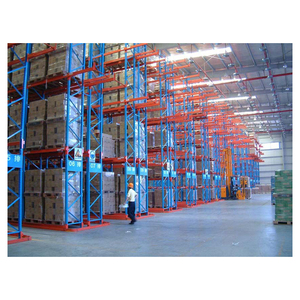
Engineering Excellence in Automated Pallet Racking Export
An architectural breakdown of structural integrity, cold-chain robotics integration, and material physics for modern intralogistics.
Modern supply chains demand unprecedented storage density, high-velocity throughput, and zero-error inventory execution. As global land costs escalate, warehouse logistics operators are moving away from traditional static selective racking toward fully automated pallet racking architecture. China has emerged as the premier manufacturing epicentre for these automated systems, combining advanced cold-rolled steel metallurgy, competitive cost structures, and sophisticated robotics integration.
1. Metallurgical Integrity & Structural Steel Specifications
PrimeBay Heavy Duty Racking engineers structural storage platforms built to survive aggressive operational cycles. Upright frames are cold-formed from high-tensile structural steel coil (Q355B equivalent to S355JR according to EN 10025). Compared to standard Q235 steel, Q355B provides a minimum yield strength of $355\text{ MPa}$, allowing for higher load capacities while reducing the gross self-weight of the rack layout.
- Continuous Roll-Forming Precision: Profile uprights feature a 50mm, 75mm, or 76.2mm drop-lock teardrop pitch manufactured via 22-station automated CNC roll-forming lines to eliminate internal residual stress.
- Electrostatic Powder Coating Thickness: All components undergo a 7-stage pre-treatment wash (degreasing, phosphating, deionized rinse) followed by thermosetting epoxy-polyester powder coating applied at $60\text{--}80\ \mu\text{m}$ thickness, achieving ISO 9227 salt spray resistance exceeding 500 hours.
- Seismic Zone Structural Calculations: Racking frames are customized with heavy-duty baseplates, expanded anchor bolt patterns, and dynamic sway bracing in compliance with Eurocode 8 (EN 1998) and RMI (ANSI MH16.1) seismic standards.
2. Architecture of Automated Pallet Shuttle & ASRS Systems
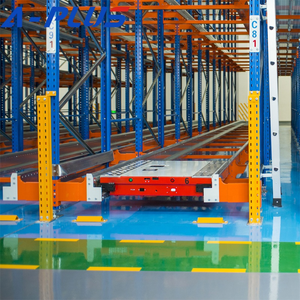
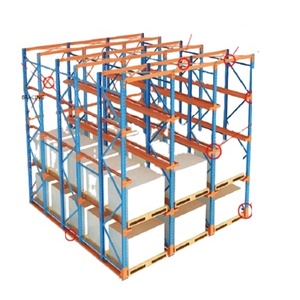
Automated shuttle racking systems utilize self-propelled radio runners (2D pallet runners or 4-way intelligent shuttles) operating within engineered guide rails inside storage channels. This eliminates forklift travel aisles, reclaiming up to 70% of wasted floor volume while enabling both FIFO (First-In, First-Out) and LIFO (Last-In, First-Out) inventory control strategies.
2D Radio Shuttle Runner
Battery-powered units lifting up to 1,500kg per pallet. Equipped with photoelectric sensors, obstacle detection bumpers, and wireless remote control interface.
4-Way Directional Robotics
Multi-directional shuttles capable of switching tracks between depth channels and main cross-aisles. Integrated with vertical lifts for full matrix storage.
ASRS High-Bay Structures
Automated Storage & Retrieval Systems up to 40 meters tall, designed with tight deflection thresholds ($L/200$) for stacker crane interface.
3. Quantitative Selection Matrix: Storage System Capabilities
Choosing the correct racking geometry depends on SKU diversity, pallet turnover rate, and warehouse clear height. The engineering matrix below highlights performance tradeoffs:
| Storage Racking System Type | Storage Density (%) | Pallet Selectivity | Operating Speed / Throughput | Ideal Application Industry |
|---|---|---|---|---|
| Automated Radio Shuttle Racking | 85% - 90% | Lane Selective (LIFO/FIFO) | High (Automated Runner) | Cold Storage, Food & Beverage, FMCG |
| 4-Way Shuttle ASRS Matrix | 90% - 95% | 100% Automated Matrix | Very High (Robotic Fleet) | E-Commerce fulfillment, Pharmaceuticals |
| Very Narrow Aisle (VNA) Rack | 65% - 75% | 100% Direct Access | Medium-High (Turret Truck) | High-Bay Spare Parts, Industrial Hardware |
| Push Back Cart Racking | 70% - 80% | 2-6 Deep per Lane (LIFO) | Medium (Forklift Push) | Chemicals, Medium-SKU Distribution |
| Selective Pallet Racking | 40% - 50% | 100% Direct Access | Standard (Standard Reach Truck) | General 3PL Logistics, Raw Material Store |
Future Warehouse Procurement Trends (2025–2035)
Key structural and digital shifts redefining automated pallet storage sourcing from China.
1. Deep Cold-Chain Optimization (-30°C Operation)
Energy expenses account for up to 60% of cold storage operational budgets. Automated 4-Way Shuttle Racking reduces refrigerated cube volume requirements by 40% while operating seamlessly with low-temperature Lithium Iron Phosphate (LiFePO4) battery cells without thermal degradation.
2. Green Steel Fabrication & Low-Carbon Footprint
Global buyers are demanding verified ESG compliance. Top Chinese exporters are adopting scrap-based Electric Arc Furnace (EAF) steel production and solvent-free powder coatings, providing Environmental Product Declarations (EPD) to support LEED-certified logistics centers.
3. IoT-Enabled Structural Health Monitoring
Modern high-bay racking incorporates strain-gauge sensors and collision detectors linked to WMS/WCS software. Real-time telemetry alerts operations when forklift impacts exceed allowable structural thresholds, preventing catastrophic frame failure.
4. Modular Rack-Supported Buildings (Clad-Rack)
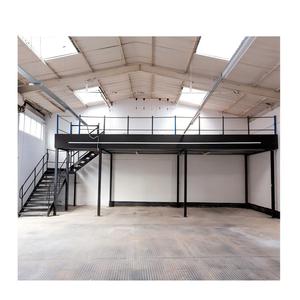
Instead of constructing a building and installing racks inside, rack-supported structures utilize the racking uprights as the load-bearing framework for exterior wall cladding and roof panels, slashing civil construction timelines by 30%.
Why PrimeBay is China’s Leading Automated Racking Exporter
Direct-from-factory manufacturing precision backed by certified engineering oversight.
PrimeBay Heavy Duty Racking Co., Ltd. operates a state-of-the-art 40,000 m² industrial production complex in Guli Industry District, Nanjing, Jiangsu Province. Since 2006, our engineering teams have bridged the gap between Chinese steel fabrication power and international quality compliance.
Certified Compliance
Production facilities strictly ISO 9001 (Quality), ISO 14001 (Environment), CE Mark compliant, and audited by TUV Rheinland.
Complete OEM/ODM Customization
Dedicated R&D department engineering bespoke beam profiles, custom RAL color palettes, and branded packaging for international distributors.
10-Year Warranty & Support
Structural warranty backing every rack system, paired with installation CAD drawings, video guidance, and onsite engineering supervisors.
Frequently Asked Questions by Global Racking Importers
Direct technical answers to critical questions asked during international racking tenders.
Which international design standards do PrimeBay automated racking systems follow?
All PrimeBay pallet racking systems are engineered according to European FEM 10.2.02 / FEM 10.2.09 standards, EN 15512 (Steel static storage systems), EN 15620, EN 15625, and American RMI (ANSI MH16.1) guidelines. Structural calculations, FEA simulation reports, and mill test certificates (MTC) are supplied with every order.
How does PrimeBay guarantee rail and beam alignment tolerances for radio shuttle runners?
Shuttle guide rails are roll-formed using specialized high-precision tooling to ensure a longitudinal tolerance within $\pm 0.5\text{mm}$ per section. Connection brackets feature CNC-punched indexing slots that prevent cumulative pitch misalignment across deep storage lanes up to 40 meters.
What information is required to receive an engineered layout and cost quotation?
To generate an optimized CAD proposal, please provide: (1) Warehouse floorplan with building column grid and clear height under roof trusses; (2) Pallet dimensions ($L \times W \times H$ including goods); (3) Maximum unit load weight per pallet; (4) Required storage capacity and throughput; (5) Forklift truck models or automated handling equipment specs.
What are the lead times for manufacturing and sea freight shipment from Nanjing, China?
Standard manufacturing lead time is 15 to 25 calendar days for containerized shipments (approx. 3-5 containers). Delivery to Nanjing Port or Shanghai Port takes 2-3 days. Total transit time depends on the destination port (e.g., West Coast USA: 14-18 days; Europe: 28-35 days; Middle East: 18-22 days).
How do you prevent product damage and corrosion during ocean transport?
All upright frames, beams, and shuttle rails are bundled using heavy-duty steel strapping with protective plastic edge protectors, wrapped in moisture-barrier PE shrink film, and elevated on wooden dunnage blocks for safe forklift unloading. Small hardware components are packed in reinforced wooden crates.