info@primebayrack.com Exporting racking systems to 85+ countries
CE · ISO 9001 · ISO 14001 · TUV English
0%

Drive-Through Pallet Racking is built for operations that store many pallets of the same product. Forklifts enter deep lanes, placing pallets from the back and retrieving them from the front. The result can be striking: more pallet positions, fewer aisles, and less wasted floor space. But density is not a free gain. A blocked lane, uneven inventory rotation, or poorly matched forklift can quickly undermine the layout.

Industry investment points to why rack selection matters. MHI’s 2024 Annual Industry Report identifies technology adoption and automation as continuing supply-chain priorities. Grand View Research also projects substantial growth in the global warehouse automation market, reflecting pressure to improve throughput and space use. These reports do not measure demand for drive-through racks specifically. That distinction matters. A broad automation trend is not proof that every warehouse needs deep-lane storage.

MIT supply-chain expert Yossi Sheffi has said, “The purpose of supply chains is to serve customers.” Applied here, the best system is not simply the one holding the most pallets. It must support the site’s product mix, replenishment rhythm, safety practices, and equipment. Small details matter: clear lane markings, consistent pallet dimensions, and enough room for a forklift to turn. This guide compares ten worldwide manufacturers through that practical lens, including design capability, customization, service, and suitability for different operations. No ranking can replace a site survey. And specifications deserve a second look. A rack can appear efficient on paper, yet feel awkward on a busy warehouse floor.
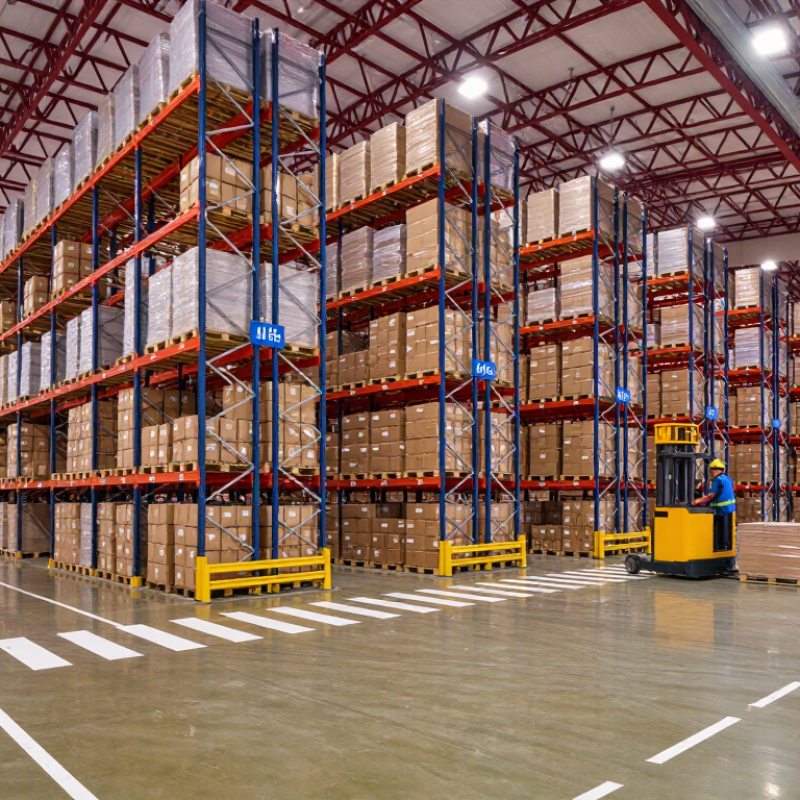
Top 10 Drive Through Pallet Racking Manufacturers Worldwide

How Drive-Through Pallet Racking Systems Operate

Drive-through pallet racking stores pallets on rails inside deep lanes, with access from both ends. A forklift enters one end, places a pallet on the rails, and withdraws carefully. Other pallets move deeper into the same lane, reducing the number of access aisles needed.

The system usually follows first-in, first-out inventory flow. Operators load from one side and retrieve from the opposite side, so goods move through the lane in sequence. This works well when a lane holds one product type and stock turns over regularly. Clear lane labels help prevent retrieval mistakes. Forklift mast height, turning clearance, pallet condition, and rail capacity all affect safe operation. Small mismatches matter.

During unloading, the forklift enters from the retrieval end and removes the front pallet, allowing the next one to move forward. Operators should follow the rack design’s loading pattern and avoid striking rails with forks. The trade-off is easy to underestimate: deep lanes save floor space, but a blocked pallet can delay access to stock behind it. Real pallets are not always perfectly uniform, either. A slightly damaged base may sit poorly on the rails, so routine inspection and trained handling are essential.

Top 10 Drive-Through Pallet Racking Manufacturers Worldwide — How Drive-Through Pallet Racking Systems Operate

A comparison of the accessible ends in two common pallet-racking configurations

How it works: In drive-through racking, a forklift can enter a storage lane from one end and exit from the other. With access at both ends, the system can support first-in, first-out stock rotation when loading and unloading are managed accordingly. Drive-in racking has one accessible end and is commonly operated on a last-in, first-out basis.

Key Design Features and Warehouse Applications

Drive-through pallet racking is designed for dense storage where forklifts enter storage lanes to place or retrieve pallets. The structure uses deep lanes with rails supporting pallets above the floor. Because there are fewer access aisles, a warehouse can use more of its available footprint for storage. That gain comes with a trade-off: operators have less direct access to individual pallets.

Good designs account for pallet dimensions, load weights, forklift clearance, and the condition of the floor. Uprights and beams must be selected for the intended loads, while lane depth should match the facility’s inventory rotation. In practice, this system often suits cold stores and warehouses holding large batches of similar goods. It is less convenient when stock changes frequently or staff need to reach a specific pallet quickly. Access matters. A damaged rail or poorly aligned pallet can also disrupt a lane, so routine inspection is important.

Tips: Keep pallet sizes consistent and train forklift operators to enter lanes slowly. Check rails, uprights, and load signs regularly. One detail is easy to overlook: high storage density can complicate stock rotation, so review picking patterns before expanding lane depth.

Criteria for Evaluating Global Manufacturers

Criteria for Evaluating Global Manufacturers

A drive-through rack must fit the warehouse’s actual pallet sizes, forklift turning radius, and loading sequence. Ask manufacturers to show clearances on a layout drawing, not just quote a storage capacity. Check load calculations for the rack, floor, and local seismic conditions. Request design documentation and evidence of testing against relevant standards, such as ANSI/RMI MH16.1. A tidy specification sheet can still hide awkward replenishment.

MHI’s 2024 Annual Industry Report found that 55% of surveyed supply-chain professionals planned to increase investment in innovation. That figure reflects wider pressure to improve operations, not proof that any rack design performs well. Compare manufacturers on engineering support, installation guidance, inspection advice, and replacement-part availability. Ask how they protect uprights at busy aisle ends, where small forklift impacts can accumulate. Ask for proof.

Global sourcing adds practical checks: confirm steel and coating specifications, production lead times, shipping plans, and local service coverage. Request references for projects with similar pallet loads and operating conditions. A low initial quote may omit installation or future repairs; compare the full operating cost. I would also ask who reviews changes after the system is installed. That point is easy to overlook.

Top 10 Drive Through Pallet Racking Manufacturers Worldwide - Criteria for Evaluating Global Manufacturers
No. Evaluation criterion Suggested weight What to evaluate Evidence and relevant references
1 Structural design and load engineering 18% Check that the proposed system is engineered for the specified pallet loads, bay geometry, rack height, floor conditions, seismic requirements, and operating clearances. Confirm that calculations address drive-through configuration and the absence of conventional access aisles within the lanes. Request project-specific design calculations, load tables, drawings, and stated assumptions. In Europe, EN 15512 covers structural design principles for adjustable steel static pallet racking; other regions use their applicable design rules.
2 Standards and regulatory alignment 16% Assess whether the supplier can identify the standards and local building, seismic, fire, and workplace-safety requirements applicable to the installation location. Confirm the edition and scope of each cited standard. Examples of regional references include EN 15512, EN 15620, EN 15629, and EN 15635 in Europe; ANSI MH16.1 in North America; and AS 4084 in Australia. Applicability depends on jurisdiction and project scope.
3 Drive-through product suitability 10% Verify the system is designed for the intended loading method, pallet dimensions, forklift type, lane depth, stock rotation policy, and required storage density. Review entry guides, lane supports, bracing, and end-of-lane protection. Use layout drawings and a handling-equipment review to confirm clearances and operating sequence. Drive-through racking is generally suited to access from both ends; confirm the proposed configuration matches the site's inventory-flow requirements.
4 Manufacturing and quality controls 12% Review controls for incoming materials, forming, welding, dimensional checks, coating, non-conforming products, and final inspection. Ask how production changes are controlled between approved design and delivered equipment. Request documented inspection and quality procedures, sample inspection records, and relevant third-party audit evidence. ISO 9001 concerns quality management systems; certification alone does not establish rack design capacity or product performance.
5 Material specification and traceability 8% Confirm steel grades and thicknesses are stated in the design and that supplied components can be linked to production batches. Check whether substitutions require engineering approval. Request material certificates or equivalent records and a documented component identification method. Compare the delivered parts with the approved drawings and bill of materials.
6 Corrosion protection and service environment 8% Match the coating system to indoor or outdoor use, humidity, temperature, cleaning chemicals, and other site exposure. Review coating coverage at edges, joints, and areas affected by fabrication. Ask for the coating type, specified thickness or performance requirements, inspection method, and maintenance guidance. ISO 1461 specifies requirements and test methods for hot-dip galvanized coatings on fabricated iron and steel articles; suitability still depends on the application.
7 Customization and system integration 8% Evaluate the ability to accommodate non-standard pallet sizes, building constraints, sprinkler and lighting layouts, floor tolerances, and interfaces with conveyors or warehouse-management processes. Request coordinated general-arrangement drawings, interface details, and written confirmation of design responsibility for modified or integrated components.
8 Installation planning and delivery capability 6% Review the proposed schedule, packaging and shipment plan, site sequencing, installation method, and coordination with ongoing warehouse operations. Confirm responsibilities for unloading and site readiness. Compare a project schedule and delivery plan with the site's access restrictions, installation window, and required handover date. Ask for references for projects of similar scale and complexity.
9 Inspection, maintenance, and after-sales support 8% Check the availability of inspection guidance, damage reporting procedures, repair or replacement parts, and technical support after handover. Ensure responsibilities for routine inspections are clear. EN 15635 provides guidance on the use and maintenance of steel static storage systems in its scope. Request operating instructions, inspection records or templates, and a written support and spare-parts policy.
10 Technical documentation and handover 6% Assess whether the handover package clearly identifies safe working loads, configuration limits, component locations, inspection requirements, and approved as-built changes. Request approved drawings, load notices, installation and operating instructions, inspection guidance, and as-built documentation in the languages and formats required at the site.

The percentages are a suggested comparison framework, not an official industry rating. Apply the same evidence requirements to every bidder, verify current standards and local requirements for the project location, and do not treat a certification or product brochure as a substitute for project-specific engineering review.

Top 10 Drive-Through Pallet Racking Manufacturers Worldwide

Drive-through pallet racking allows forklifts to enter storage lanes and place pallets on supporting rails. Access at both ends can support first-in, first-out flow. Single-ended access usually serves last-in, first-out storage. Terminology varies between suppliers, so drawings should clearly define the intended loading sequence. Details matter. This distinction affects stock rotation, aisle planning, and daily forklift movements.

A useful comparison of the top ten worldwide manufacturers should examine engineering, not catalogue size alone. Look for documented load ratings, clear installation instructions, and support for site-specific layouts. Ask how each design handles uneven floors, pallet variation, impact protection, and local seismic conditions. Confirm that beams, rails, and uprights match the proposed pallet loads. Reference projects with similar weights and operating intensity can reveal practical experience.

Manufacturing quality is only part of the decision. Lead times, replacement parts, installer training, and after-sales response can affect warehouse uptime for years. Compare the scope behind each quotation; coatings, tolerances, and safety accessories may differ. A low price can hide a costly compromise. There is no perfect layout. Narrow lanes may increase storage density, yet leave less room to recover when a pallet is damaged or placed poorly. That trade-off deserves careful review before purchase.

Comparing Manufacturers by Capacity, Safety, and Service

Comparing drive-through pallet racking manufacturers takes more than checking advertised storage capacity. Ask for load calculations based on pallet weight, dimensions, and the number of levels. A system designed for dense storage must also suit your forklift type and aisle approach. Request drawings that show clearances, upright protection, and the planned loading sequence. Small details matter.

Safety deserves close inspection. Look for clear operating guidance, visible load signs, and replaceable impact protection at entry points. Ask how the manufacturer checks rack condition after installation and what documentation comes with the system. A confident sales pitch is not enough. Service matters, too: confirm response times, spare-part availability, and whether trained technicians can support your location. These details may vary by region, so compare written commitments rather than broad promises.

Tips: Share a real warehouse layout and sample pallet measurements when requesting quotations. Ask each supplier to explain one design assumption you can verify. Then compare capacity, safety features, and after-sales support side by side. One limitation is easy to miss: the highest storage density may not deliver the smoothest daily operation. Walk through a proposed loading plan with your operators before choosing.

FAQS

How does drive-through pallet racking work?

A forklift enters one end and places pallets on internal rails. It then withdraws carefully. More pallets move deeper into the lane.

How does stock move through the lane?

Operators load from one end and retrieve from the opposite end. This supports first-in, first-out flow. Clear lane labels help prevent mistakes.

What happens when a pallet is unloaded?

The forklift enters from the retrieval end and removes the front pallet. The next pallet can then move forward. Avoid striking the rails.

What can affect safe operation?

Check forklift mast height, turning clearance, pallet condition, and rail capacity. Small mismatches matter. A damaged pallet base may sit poorly on the rails.

How does drive-through storage differ from single-ended access?

Access at both ends can support first-in, first-out flow. Single-ended access usually supports last-in, first-out storage. Supplier terminology varies, so drawings should show the loading sequence.

What should buyers compare between rack designs?

Review documented load ratings and installation instructions. Ask how the design handles uneven floors, pallet variation, and forklift impacts. Details matter.

What is the main space-saving trade-off?

Deep lanes reduce the need for access aisles. But a blocked or poorly placed pallet can delay access to stock behind it. That cost is easy to underestimate.

What should a quotation include beyond the rack itself?

Compare coatings, tolerances, safety accessories, lead times, replacement parts, and installer training. A low price may hide a compromise. I would check the fine details twice.

Conclusion

This article explains how Drive-Through Pallet Racking works, with forklifts entering the rack lanes to load and retrieve pallets from designated access points. It describes the system’s main design features, including deep storage lanes, rail-supported pallets, and layouts suited to high-volume inventories with fewer product types. The summary also considers warehouse applications where efficient use of floor space and organized pallet movement are important.

To compare manufacturers worldwide, the article outlines practical evaluation criteria such as storage capacity, structural quality, safety features, customization options, installation support, and after-sales service. It then presents ten manufacturers for consideration and compares their strengths across these areas. Rather than focusing on a single supplier, the guide helps warehouse operators identify which capabilities best match their building, inventory, handling equipment, and operational needs.

Oliver

Oliver

Oliver is a professional marketing specialist who combines a deep understanding of the company’s products with a clear, customer-focused approach to communication. Through regular articles on the company website, he explains product features, practical applications, and industry developments in an......