Warehouse space is expensive, and every wasted aisle can reduce daily productivity. Narrow Aisle Pallet Racking helps facilities store more pallets without expanding their building footprint. However, higher density does not automatically create a better warehouse. Forklift type, pallet dimensions, floor quality, fire protection, operator training, and product turnover must work together.
Gwynne Richards, warehouse management author and consultant, says, “Good warehouse design balances space, accessibility, and safety.” That principle guides this review of the seven best Narrow Aisle Pallet Racking systems for 2026. The comparison considers selective narrow aisle racks, double-deep configurations, very narrow aisle solutions, mobile racking, and automated options. Each system has a different operating logic. Some improve storage density. Others protect faster picking access.
Real warehouses rarely match a perfect design drawing. A narrow aisle may look efficient until a reach truck struggles with uneven concrete or poor lighting. Small errors matter. A few extra seconds per pallet can become hours each week. This guide therefore examines practical details, including aisle clearance, lift-truck compatibility, load capacity, installation complexity, maintenance demands, and worker visibility.
The strongest system depends on the operation, not the trendiest specification. A high-volume distributor may value rapid access more than maximum density. A slower-moving inventory profile may justify deeper storage. This article also recognizes an uncomfortable point: no racking system eliminates every compromise. Careful measurement remains essential. Local safety requirements and manufacturer recommendations should always guide the final design.
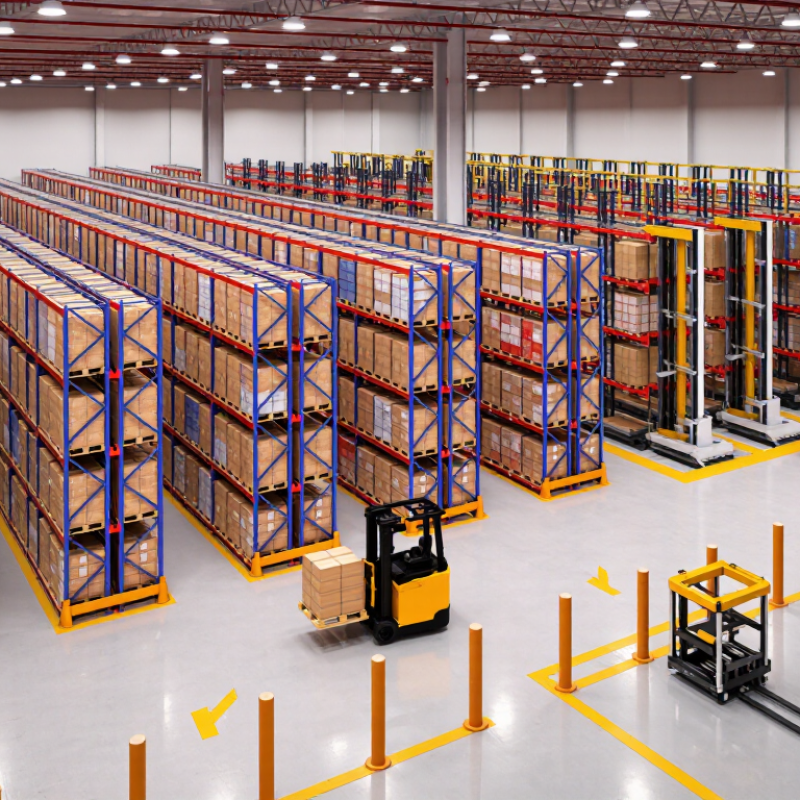
Narrow aisle pallet racking reduces aisle width while preserving direct pallet access. It suits warehouses where floor space is limited and vertical storage is valuable. A typical structure includes upright frames, horizontal beams, pallet supports, guards, and floor anchors. Some designs also use guide rails or induction wires for guided trucks. The seven leading system types differ in access speed, truck requirements, and storage density.
Its operating principle is simple but precise. A forklift enters a controlled aisle, aligns with the rack, and places pallets at selected beam levels. Very narrow aisle systems often require turret or articulated trucks. Double-deep layouts store one pallet behind another, improving density but reducing immediate access. Mobile racks move along floor rails, opening one working aisle when needed. In my experience, small alignment errors can damage pallets or frames. That detail is easy to underestimate.
Tips: Measure the full truck turning path, not only the rack spacing. Check load ratings at every beam level. Add visible guards near corners and impact zones. Train operators with the actual pallet sizes used onsite. Review aisle clearance after installation, because real operations rarely match the original drawing perfectly. A well-designed system balances capacity, retrieval time, safety, and future changes.
Selecting a narrow aisle pallet racking system starts with the warehouse, not the product brochure. Measure clear height, aisle width, slab strength, column spacing, and emergency access. A few centimeters can affect forklift movement.
Check the pallet dimensions and actual load weights from daily operations. Include damaged pallets, uneven loads, and seasonal inventory peaks. The system must match the reach truck’s turning radius and lifting height.
Operators need clear sightlines at intersections. Poor lighting or floor damage can reduce safe capacity, even when the rack appears suitable.
Fire protection also matters. Sprinkler clearance, inspection routes, and local building requirements should be reviewed with a qualified engineer.
Choose adjustable beams if product sizes change often, but do not assume flexibility solves every problem. Fixed locations may improve control for uniform stock.
In practice, warehouses often underestimate battery-charging space and pedestrian separation. That mistake can disrupt the whole aisle plan. Test one representative aisle with a loaded truck before approving the full installation. Performance may look different during a busy shift.
In 2026, seven systems deserve close comparison: narrow-aisle selective, VNA turret, double-deep, push-back, pallet-flow, mobile, and pallet AS/RS. Narrow-aisle selective offers familiar access and lower training demands. VNA turret systems use aisles near 1.6 metres, but require guided trucks and precise floor control. Double-deep storage improves density, although rear pallets reduce immediate access. Push-back racks suit several pallets per SKU. Pallet-flow racks support fast FIFO movement, especially for chilled or dated goods. Mobile racks save floor space, yet movement speed can disappoint during peak picking. Pallet AS/RS delivers high density and consistent retrieval, but demands stronger software and capital planning.
The MHI 2024 Annual Industry Report states that 91% of surveyed supply-chain professionals planned to increase technology investment within two years. That figure supports automation, but it does not make every warehouse ready for AS/RS. A 2024 report from Interact Analysis also projects continued warehouse automation growth, driven by labor pressure and e-commerce expectations.
Site measurements still matter more than fashionable equipment. Measure beam height, pallet weight, fire clearances, floor flatness, and daily retrievals. A VNA layout may look excellent on paper. Then a damaged pallet blocks the only working aisle. That risk is easy to overlook. My practical preference is a staged comparison: model capacity, travel time, error rates, and maintenance access before selecting the densest option.
Narrow aisle warehouses need more than compact storage. They need a careful balance between capacity, access, safety, and automation. Seven practical systems deserve attention in 2026: selective narrow aisle racking, very narrow aisle racking, double-deep racking, mobile racking, push-back racking, pallet shuttle systems, and automated storage and retrieval systems.
Capacity changes with every choice. Selective racking offers direct access to each pallet but uses more floor space. Double-deep and push-back designs increase density, yet they reduce immediate access. Mobile racks can create moving storage lanes, while shuttle systems support high-volume pallet movement. Automated systems may use vertical space efficiently, but they require stable pallets, accurate data, and reliable maintenance planning. More automation is not always better.
Accessibility depends on product turnover and picking equipment. A very narrow aisle layout may need specialized trucks and precise operator training. Even a few centimeters of pallet overhang can create delays or damage. Safety inspections should check frame anchors, beam locks, aisle clearance, floor condition, and load labels. Keep pedestrian routes separate where possible. Small details matter.
Real warehouse measurements should guide the design. Record pallet dimensions, load weights, ceiling height, travel patterns, and peak inventory levels. Do not trust average figures alone. Seasonal demand can expose weak assumptions. A layout that works in March may struggle in November. Capacity calculations should include damaged pallets, maintenance access, and emergency movement space. No system is perfect. The best choice is the one workers can use consistently and safely.
| System | Typical Clear Aisle Width | Typical Load Capacity | Space Utilization | Pallet Accessibility | Best-Fit Warehouse Profile | Key Safety Considerations | Automation Potential | Overall Suitability |
|---|---|---|---|---|---|---|---|---|
| Very Narrow Aisle (VNA) Turret-Truck Racking | 1.6–2.0 m | 600–1,500 kg per pallet position, subject to beam and frame design | Very high; maximizes storage density while retaining direct pallet access | Excellent; every pallet is directly accessible | High-volume distribution centers with tall buildings, standardized pallets, and high SKU turnover | Requires guided travel, protected end-of-aisle zones, rack protection, floor-flatness control, and trained operators | High; supports wire guidance, warehouse control systems, positioning aids, and semi-automated turret trucks | ★★★★★ |
| Narrow-Aisle Selective Pallet Racking | 2.4–3.0 m | 500–1,500 kg per pallet position, depending on rack geometry and beam rating | High; better density than conventional selective layouts | Excellent; one-pallet-deep storage provides direct access to all locations | Warehouses requiring broad SKU variety, frequent replenishment, and reliable first-in/first-out control | Use rack guards, load notices, back guards where required, regular inspections, and properly rated lift trucks | Medium to high; compatible with barcode/RFID, guided trucks, pick-to-light, and inventory software | ★★★★★ |
| Double-Deep Pallet Racking | 2.8–3.5 m | 700–1,500 kg per pallet position, depending on beam span and handling equipment | High; adds storage depth and reduces aisle count | Good; direct access to the front pallet, with the rear pallet accessed after front-load movement | Medium-to-high-volume operations with several pallets per SKU and relatively stable inventory | Requires reach-truck load-depth controls, pallet stops or position indicators, rear-load protection, and careful load sequencing | Medium; suitable for inventory control systems, guided reach trucks, and pallet-position sensors | ★★★★☆ |
| Pallet Shuttle Racking | 1.7–2.5 m for shuttle lanes, depending on the loading method | 800–1,500 kg per pallet position, with heavier designs available after engineering review | Very high; deep lanes reduce aisles and improve cubic utilization | Moderate to good; individual pallets are not all directly face-accessible, but shuttle movement reduces forklift entry | High-volume, low-to-medium SKU environments with repeated pallet loads and batch storage requirements | Needs lane stops, shuttle interlocks, controlled access, battery-management procedures, and routine rail and pallet inspections | Very high; remote shuttles, automatic pallet identification, conveyor interfaces, and warehouse control integration are available | ★★★★☆ |
| Mobile Pallet Racking | One active aisle of approximately 1.5–3.0 m; closed rows occupy minimal circulation space | 500–1,500 kg per pallet position, subject to base, rack, and floor design | Very high; minimizes the number of permanently open aisles | Good; access is available by opening the required aisle, but simultaneous access is limited | Cold stores, archival or secure storage, and facilities where floor area is more constrained than picking speed | Requires safety light curtains, presence detection, emergency stops, anti-crush controls, floor surveys, and aisle access rules | High; motorized bases can connect to warehouse software, barcode systems, and automated access requests | ★★★★☆ |
| Pallet Flow Racking | 2.7–3.5 m for forklift access, depending on rack layout | 500–1,000 kg per pallet position is common; roller and brake capacity must be specified | High; deep lanes provide strong storage density and organized product flow | Good; front loading and rear picking can support first-in/first-out rotation | Perishable goods, date-sensitive inventory, and operations with predictable pallet flow and high throughput | Requires speed controllers, lane separators, pallet compatibility checks, impact protection, and routine roller inspection | Medium to high; integrates well with conveyors, pallet dispensers, sensors, and warehouse control systems | ★★★★☆ |
| Automated Storage and Retrieval System (AS/RS) for Narrow Aisles | Approximately 1.0–1.8 m for crane aisles, depending on load type and equipment design | 500–1,500 kg per pallet position is typical; project-specific engineering determines the final rating | Extremely high; uses building height and narrow machine aisles efficiently | Excellent at the system level; automated cranes access stored pallets, while operator access is controlled | Large, high-throughput facilities requiring accurate inventory, predictable processes, and reduced manual travel | Requires interlocked guarding, restricted access, emergency recovery procedures, fire protection coordination, and preventive maintenance | Very high; designed for warehouse management, warehouse control, conveyors, robotics, and automatic identification systems | ★★★★★ |
Note: The capacity and aisle-width figures are typical planning ranges, not guaranteed ratings. Final specifications must be verified against pallet dimensions, rack geometry, floor capacity and flatness, seismic conditions, fire-protection requirements, lift-truck or automation equipment, and applicable local safety standards.
Narrow aisle pallet racking can increase storage density, but installation quality determines its real value. Aisles should match the turning radius of the chosen truck, load dimensions, and floor tolerances. Anchors must follow the engineer’s drawings, not an installer’s guess. The Material Handling Industry’s 2024 Annual Industry Report found that 55% of respondents planned to increase supply-chain innovation investment. That investment should include accurate rack layouts and digital inspection records, not automation alone.
Maintenance needs a visible routine. Inspect uprights, beams, anchors, guards, and pallets at least monthly, and after every collision. Remove damaged components from service immediately. Small bends become expensive failures. OSHA’s storage guidance requires stable stacking and secure storage, while EN 15635 recommends documented rack inspections and competent-person reviews. Local codes still control. Do not copy a foreign checklist without checking site requirements. This is where many projects become imperfect.
Tips: Mark each aisle with a load limit and inspection date. Photograph damage before repair. Keep spare beam locks and protectors nearby. During selection, compare clear height, forklift compatibility, seismic design, future pallet sizes, and replacement-part availability. MHI’s report also identifies workforce capability as a continuing operational concern; therefore, train operators before commissioning, then refresh training after layout changes. A cheaper system may look efficient for one year. It may not remain efficient when inventory profiles change. Question the forecast. That matters.
This comparison shows typical planning aisle widths for seven pallet-racking configurations. Actual requirements vary with pallet dimensions, lift-truck specifications, building clearances, fire-protection rules, and operating procedures. Narrower aisles can improve storage density, but they normally require more specialized equipment and stricter maintenance controls.
Measure clear height, aisle width, slab strength, column spacing, and emergency access. A few centimeters matter.
Record pallet dimensions, real load weights, damaged pallets, uneven loads, and seasonal inventory peaks. Average figures can mislead.
Match the system with the truck’s turning radius and lifting height. Check sightlines at aisle intersections.
Selective narrow aisle racking provides direct access to each pallet. It usually needs more floor space.
Double-deep, push-back, and mobile systems increase density but reduce immediate access. Busy shifts may expose delays.
Check frame anchors, beam locks, aisle clearance, floor damage, and load labels. Small defects can reduce safe capacity.
Review sprinkler clearance, inspection routes, and local building requirements with a qualified engineer. Safety space cannot be treated as spare storage.
Automated systems need stable pallets, accurate inventory data, and reliable maintenance planning. More automation is not always better.
A loaded truck may move differently during a busy shift. Testing can reveal turning, visibility, and clearance problems.
Compare normal and peak inventory levels, such as March and November conditions. A layout that works in March may struggle later.
This guide explains Narrow Aisle Pallet Racking, including its structure, operating principles, and role in maximizing warehouse storage capacity. By reducing aisle width while maintaining organized pallet access, these systems can make better use of vertical space and improve inventory density. The article also outlines key warehouse requirements, such as available ceiling height, pallet dimensions, forklift compatibility, floor conditions, throughput needs, and the desired level of accessibility.
It compares seven narrow aisle pallet racking systems in 2026, focusing on capacity, selectivity, safety, automation potential, and suitability for different warehouse layouts. Readers will also learn how to evaluate installation planning, operator training, inspection routines, load management, and long-term maintenance. By balancing storage efficiency with accessibility, safety, and future expansion, warehouse managers can select a reliable racking solution that supports daily operations and adapts to changing business requirements.